- The Situation Room
- Posts
- The Situation Room - April 15th
The Situation Room - April 15th

Atlas News
April 15, 2026
Good morning everyone,
I’m Atlas, and welcome to The Situation Room! We cover the most high impact geopolitical developments every Wednesday!
Today’s topics:
Germany And Ukraine Strike Landmark Defense Deal
Israel & Lebanon Hold Direct Talks Brokered By U.S.
Mossad Chief States Iranian Regime Change Is The Ultimate Goal
Germany And Ukraine Strike Landmark Defense Deal
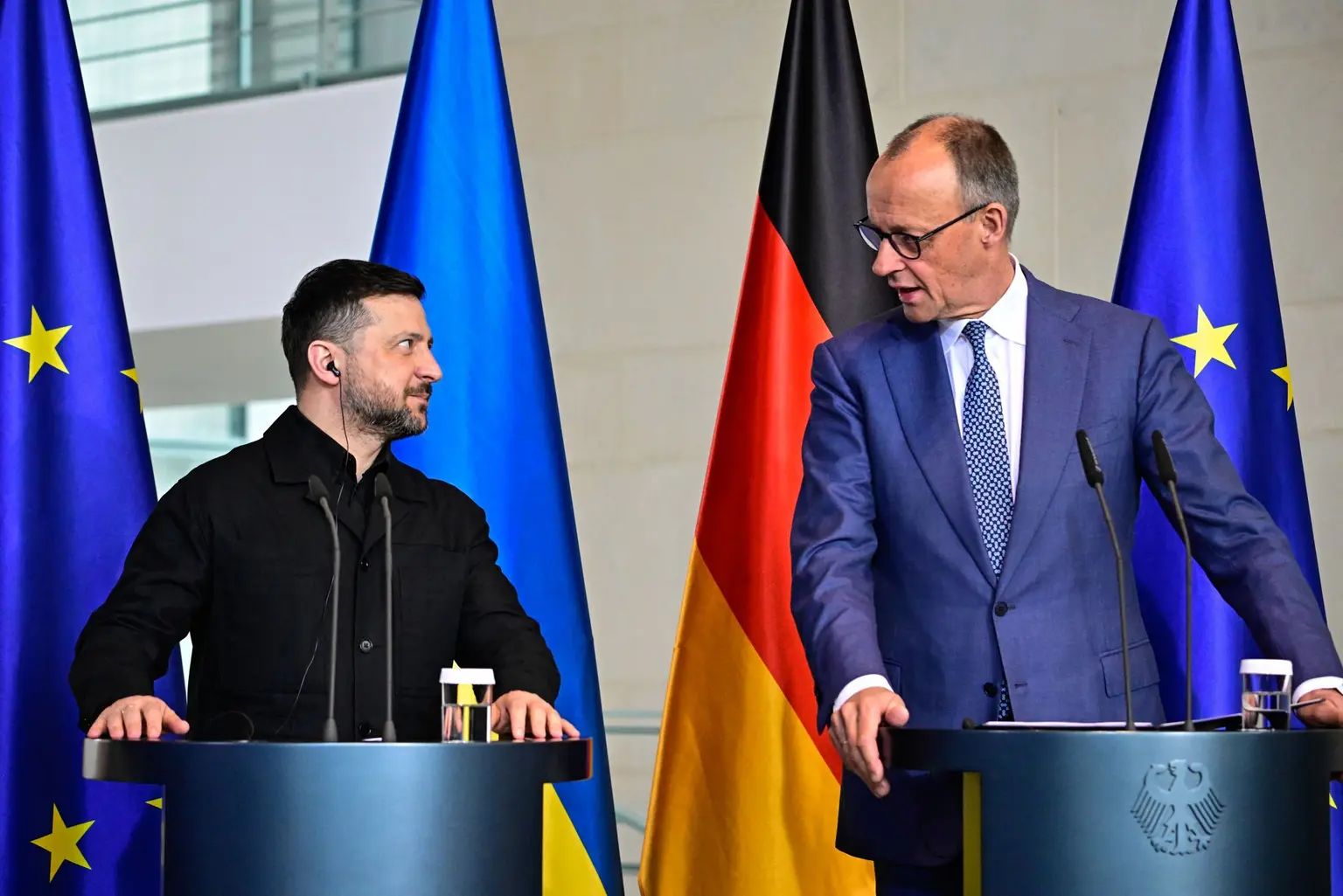
German Chancellor Friedrich Merz (R) and President Volodymyr Zelensky in Berlin on April 14, 2026. (Tobias Schwarz - AFP via Getty Images)
By: Atlas
Germany and Ukraine signed a defense cooperation agreement in Berlin on Tuesday and formally upgraded their bilateral relationship to a strategic partnership, deepening military-industrial ties at a moment when American attention has drifted toward the Middle East and Kyiv is looking to Europe to fill the gap.
President Volodymyr Zelensky led a government delegation to the German capital, where he and Chancellor Friedrich Merz announced a €4 billion defense package covering air defense, Patriot missiles, drone production, and long-range strike capabilities. The two countries also signed agreements on the electronic exchange of battlefield data and on support for Ukraine's industrial recovery — 10 cooperation agreements in all.
"No army in Europe has been as battle-tested in recent decades as Ukraine's," Merz said at a joint press conference. "No society has become more resilient than Ukraine. No defense industry has become more innovative than Ukraine's." He added bluntly: "Russia has no chance of winning the war."
The partnership was laid out in a 15-page declaration released by the German chancellery. It commits both governments to closer coordination on air defense, drones, ammunition, and long-range weapons, while also covering post-war reconstruction, anti-corruption measures, energy resilience, and Ukraine's path toward EU and NATO membership.
The Drone Deal
The centerpiece of the agreement is a joint drone production arrangement that Zelensky said could become one of the largest of its kind in Europe. Details are still being worked out, but Germany's defense ministry said the project would create a joint venture to supply thousands of drones to the Ukrainian military.
An annex to the agreement listed specific arrangements, including joint production of long-range Anubis strike drones and mid-range Seth-X drones, as well as drone supplies for third countries — including Gulf states targeted by Iranian attacks during the current Middle East conflict. Ukrainian Defense Minister Mykhailo Fedorov said the deal includes an initial production run of 5,000 AI-enhanced mid-strike drones.
"Ukrainian experience plus German engineering equals a new standard for defense tech," Fedorov posted on social media.
The drone cooperation builds on existing ties between German and Ukrainian companies. Zelensky visited a drone production facility in Munich in February that was established by a joint venture between Germany's Quantum Systems and Ukraine's Frontline Robotics. During Tuesday's talks, Quantum Systems announced two additional joint ventures with Ukrainian partners — one focused on air defense and another on unmanned ground systems.
Ukraine's drone industry has expanded rapidly since the start of Russia's full-scale invasion, producing air and sea drones, electronic warfare systems, and missiles capable of reaching roughly 1,750 kilometers into Russian territory. Zelensky said Ukraine has been approached about drone cooperation by eight Middle Eastern and Gulf countries, as well as Turkey, Iraq, and nations in Southeast Asia and Africa.
Patriot Missiles and Air Defense
Beyond drones, the €4 billion package will fund contracts for several hundred Patriot air defense missiles from U.S. manufacturer Raytheon and additional launchers for IRIS-T air defense systems from Germany's Diehl Defence. Fedorov said the package should finance 36 IRIS-T launchers and called it "a massive boost for our air defense — to protect our cities and critical infrastructure."
The air defense component carries particular urgency. More Patriot missiles were used by the United States in the first four weeks of its war against Iran than in four years of the conflict in Ukraine, delaying deliveries to both Ukraine and European allies and raising concerns about stock shortages. Ukraine remains under daily drone and missile bombardment from Russia — on the same day the deal was signed, a Russian missile strike on the eastern city of Dnipro killed five people and hospitalized 21 others.
Germany also agreed to invest several hundred million euros to finance deep-strike capabilities for Ukraine. Fedorov said Berlin would provide around €300 million to scale production of Ukrainian long-range weapons, allowing Kyiv to "strike further and more precisely, shifting the balance on the battlefield."
Sharing Battlefield Data
A less visible but potentially significant element of the agreement is a memorandum of understanding on the exchange of battlefield data. Germany will gain access to lessons learned from Ukrainian combat experience, including analysis of German weapon systems deployed in Ukraine — among them the Panzerhaubitze 2000 artillery system, the RCH 155, and the IRIS-T air defense platform.
Ukraine will also share data from its digital AI system Avenger, which detects enemy vehicles, and its battlefield management system Delta. Merz acknowledged that the data exchange would lead to the development of new weapon systems, though he declined to specify what kind.
"The fact that we are now developing such a system in Europe, together with Ukraine, also gives Europe a greater degree of independence," he said.
Zelensky framed the exchange as a two-way street. "Our experience can be incorporated into the European security system," he said. "It has proven its worth, and our experience has also proven its worth in the Middle East."
The Broader European Picture
The deal was signed against a backdrop of stalled U.S.-led diplomacy on Ukraine. American efforts to negotiate an end to the war have been sidelined since the outbreak of the Iran conflict, though the deputy U.S. ambassador to the United Nations told the Security Council on Monday that Washington would continue to push for a negotiated settlement.
Merz said Europe's involvement in any agreement with Moscow was "indispensable" and that a meeting of national security advisers was being organized, with the United States invited to participate. He stressed that Germany's commitment to Ukraine was "a very clear signal" to Russia.
The partnership also comes at a moment of potential change in European dynamics. The €90 billion EU loan for Ukraine that had been blocked by Hungarian Prime Minister Viktor Orbán may now be released following Orbán's election defeat over the weekend. Merz said the funds "must now be disbursed quickly" and that "Russia should take this seriously."
Zelensky said Ukraine was counting on Germany, as one of the EU's leading members, to help unlock the loan so Kyiv could invest in domestic production. He noted that Ukraine has the capacity to produce twice as much military equipment as it currently deploys but lacks the funding to scale up. "We simply don't have enough money," he said.
Germany has delivered approximately €55 billion in military aid to Ukraine since Russia's invasion in 2022, making it Europe's largest provider. The current budget sets aside €11.5 billion for Ukraine support. The strategic partnership announced Tuesday formalizes what has become one of the most consequential defense relationships in Europe — one that both sides are now betting can reshape the continent's security architecture for years to come.
From Berlin, Zelensky traveled to Oslo, where he and Norwegian Prime Minister Jonas Gahr Støre signed a separate defense cooperation declaration covering drones, electronic warfare, and maritime security. Norway plans €7.66 billion in support for Ukraine in 2026. A meeting of the 50-plus partner nations that coordinate weapons aid for Kyiv was scheduled for Wednesday.

Reply