- The Situation Room
- Posts
- The Situation Room - December 31st
The Situation Room - December 31st

Atlas News
December 31, 2025
Good morning everyone,
I’m Atlas, and welcome to The Situation Room! We cover the most high impact geopolitical developments every Wednesday! Happy New Years Eve!
Today’s topics:
Iran Currency Plummets, Riots Hit Tehran
Turkey Arrest Over 350 Suspects Connected To The ‘Islamic State’
Putin Calls Up Reservists To Protect ‘Critical Infrastructure’
Iran Currency Plummets, Riots Hit Tehran
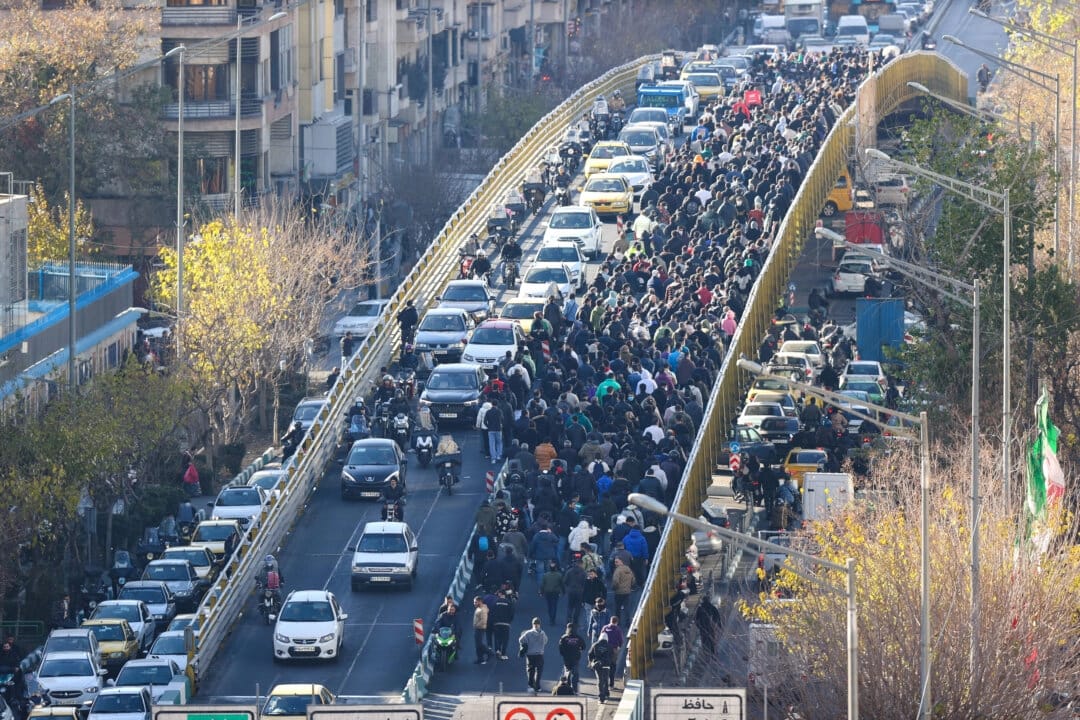
Protesters in downtown Tehran, Iran, on Dec. 29, 2025. (Fars News Agency)
By: Atlas
Protests over Iran's rapidly deteriorating economy spread to several universities on Tuesday after shopkeepers and bazaar merchants launched demonstrations in Tehran following a historic collapse of the country's currency.
The Iranian rial plunged to 1.42 million to the U.S. dollar on Sunday and was trading at roughly 1.4 million to the dollar on Tuesday, according to private exchange platforms. The currency has lost nearly half its value against the dollar in 2025, having started the year at 817,500 rials to the dollar.
The demonstrations, which began Sunday in Tehran's commercial districts including the Grand Bazaar, the mobile phone markets of Alaeddin and Charsou, and the Lalehzar electrical district, represent the first major show of public dissent since Israel and the United States carried out strikes on Iranian nuclear facilities in June.
Video of protests taking place in Tehran showed scores of people marching along streets chanting "Rest in peace Reza Shah," a reference to the founder of the royal dynasty ousted in the 1979 Islamic revolution. Footage aired on Iranian state television on Monday showed people gathered in central Tehran chanting slogans.
The semi-official Fars News Agency reported that hundreds of students held protests on Tuesday at four universities in Tehran. Other outlets reported demonstrations at seven sites. Protests also broke out at the technology university in the central city of Isfahan and at institutions in Yazd and Zanjan, according to the ILNA and state-run IRNA news agencies.
Central bank chief resigns amid turmoil
Iran's Central Bank chief Mohammad Reza Farzin resigned on Monday as protests intensified. State television reported his departure without providing details on his replacement.
When Farzin took office in 2022, the rial was trading at around 430,000 to the dollar. During the 2015 nuclear accord that lifted international sanctions in exchange for controls on Iran's nuclear program, the currency was officially trading at 32,000 rials to the dollar.
Iranian media reported that the government's recent economic liberalization policies had put pressure on the open-rate rial market, where ordinary Iranians buy foreign currency. Most businesses use official currency exchanges where the rial price is supported by the government.
The rapid depreciation has compounded inflationary pressure, pushing up prices of food and other daily necessities. According to the state statistics center, the inflation rate in December rose to 42.2% from the same period last year and was 1.8% higher than in November. Food prices rose 72% and health and medical items were up 50% from December last year.
Reports in official Iranian media indicated that government plans to increase taxes in the Iranian new year, which begins March 21, have caused additional concern among the public.
Government offers dialogue with protesters
President Masoud Pezeshkian took to social media late Monday to announce he had asked his interior minister to arrange talks to discuss the "legitimate demands" of protesters and to work on a government response.
"We have fundamental actions on the agenda to reform the monetary and banking system and preserve the purchasing power of the people," Pezeshkian wrote.
Government spokesperson Fatemeh Mohajerani said Tuesday that authorities "officially recognize" the protests.
"We hear their voices and we know that this originates from natural pressure arising from the pressure on people's livelihoods," she said in comments carried by state media.
The conciliatory tone marked a departure from the government's typical response to public dissent. Iranian authorities have quashed previous bouts of unrest with violent security actions and widespread arrests.
Pezeshkian said in a meeting with trade unions and market activists on Tuesday that the government would do its best to resolve their issues and address their concerns, according to state media.
On social media, some Iranians voiced support for the protests. One, Soroosh Dadkhah, said high prices and corruption had led people "to the point of explosion." Another, Masoud Ghasemi, warned of protests spreading across the country.
At some demonstrations, police fired tear gas to disperse crowds. Some students chanted "Death to the dictator," a reference to Supreme Leader Ayatollah Ali Khamenei, according to the BBC.
Meanwhile, the government gathered a large crowd of flag-waving supporters in the capital Tuesday for one of its regular pro-regime demonstrations.
Sanctions and military threats compound economic crisis
Iran's economy has been under severe pressure for years following the reimposition of U.S. sanctions in 2018, when President Donald Trump withdrew from the international nuclear agreement during his first term.
United Nations sanctions were reimposed on Iran in September through what diplomats described as the "snapback" mechanism, after the failure of efforts to restart nuclear disarmament talks. Those measures froze Iranian assets abroad, halted arms transactions with Tehran and imposed penalties tied to Iran's ballistic missile program.
The country also faces market anxiety over the possibility of renewed conflict with Israel following their 12-day war in June. Trump said Monday during a meeting with Israeli Prime Minister Benjamin Netanyahu that he would support Israeli strikes on Iran if Tehran attempts to rebuild its nuclear or ballistic missile programs.
Earlier this month, Iran raised gasoline prices for the first time since 2019, a move that was met with public anger.
The protests are the largest since the unrest in late 2022 and early 2023 triggered by the death of 22-year-old Mahsa Amini, a young Iranian Kurdish woman who died in the custody of Iran's morality police after being accused of not wearing her hijab properly. Iran was also hit by protests over price hikes, including for bread, in 2022.
Living costs push ordinary Iranians to the limit
The economic pressures have made daily life increasingly difficult for ordinary Iranians.
"These days, even hanging out with friends feels restricted, as we're constantly calculating like human calculators whether we can squeeze in the cost of a simple coffee," sales manager Omid, 42, told The New York Times. He said the value of his monthly income had fallen from the equivalent of $300 per month to $200 per month in the span of two months.
Another struggling Iranian, Mariam, 41, told the outlet she has also needed to tighten her spending.
"Things have gotten so expensive that over the past few days when I had guests, I was constantly crunching numbers to ensure I wouldn't run out of money before the end of the month," she said.
Esfandyar Batmanghelidj, chief executive of the Bourse and Bazaar Foundation, a London-based think tank focused on Iran's economy, told The New York Times that many Iranian leaders are beginning to understand that "their failure to listen to and meet the demands of large parts of Iranian society has undermined their legitimacy and even their authority."
"They are beginning to reckon with this fact in a haphazard and belated way," he said.
The participation of bazaar merchants in the protests carries particular significance. The Grand Bazaar played a crucial role in the 1979 Islamic revolution that ousted the monarchy and brought Islamists to power.
The government has not said what form dialogue will take with protest leaders. Pezeshkian's administration faces the challenge of addressing public anger over economic conditions while remaining under intense international pressure and the threat of further military strikes.

Reply