- The Situation Room
- Posts
- The Situation Room - January 14th
The Situation Room - January 14th

Atlas News
January 14, 2026
Good morning everyone,
I’m Atlas, and welcome to The Situation Room! We cover the most high impact geopolitical developments every Wednesday!
Today’s topics:
South Korean Prosecutors Seek Death Penalty For Former President
Trump To Iranian People: Help Is On The Way
French Political Leader Aims To Overturn Conviction & Re-Enter Presidential Race
South Korean Prosecutors Seek Death Penalty For Former President
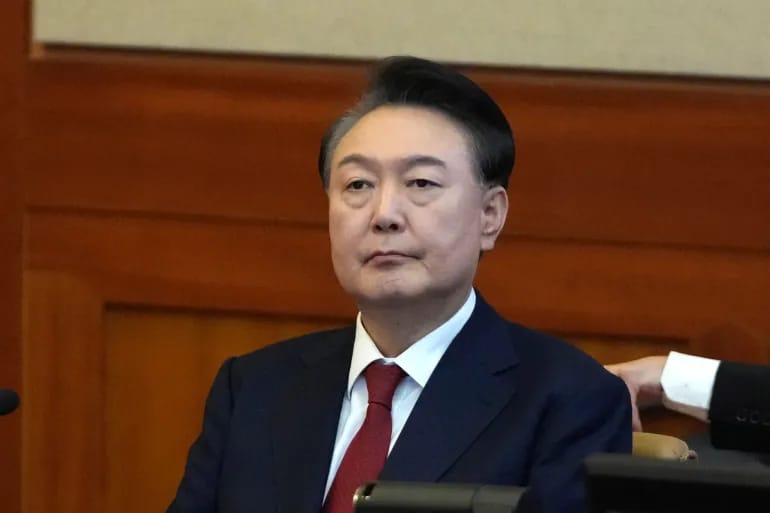
South Korea's former President Yoon Suk Yeol (Lee Jin-man - AP)
By: Atlas
South Korean prosecutors on Tuesday demanded the death sentence for former President Yoon Suk Yeol on rebellion charges stemming from his short-lived imposition of martial law in December 2024, a move that plunged the country into political chaos and led to his eventual removal from office.
Independent counsel Cho Eun-suk's team made the request to the Seoul Central District Court during the final hearing of Yoon's trial, which stretched 11 hours and wrapped up late Tuesday. The court is expected to deliver its verdict on February 19.
The 65-year-old former president, who has been detained for months while facing multiple criminal trials, denied the charges and slammed investigations into his rebellion case as "frenzied" and involving "manipulation" and "distortion."
If found guilty and the death sentence is upheld, it would mark South Korea's first execution in nearly 30 years. Amnesty International has classified the country as "abolitionist in practice," noting that while South Korea still retains the death penalty, it has not executed anyone since 1997.
Prosecutors allege 'lust for power'
Prosecutors described Yoon as the "ringleader of an insurrection" and accused him of threatening the "liberal democratic constitutional order" with what they called a "self-coup."
In closing arguments, prosecutors said the former president had been motivated by a "lust for power aimed at dictatorship and long-term rule."
"Former President Yoon declared martial law with the purpose of remaining in power for a long time by seizing the judiciary and legislature," said assistant special counsel Park Eok-su, according to South Korea's Yonhap News Agency.
"The greatest victims of the insurrection in this case are the people of this country," prosecutors told the court. "There are no mitigating circumstances to be considered in sentencing, and instead a severe punishment must be imposed."
Prosecutors said investigators confirmed the existence of a scheme allegedly directed by Yoon and his former defense minister, Kim Yong-hyun, dating back to October 2023 designed to keep Yoon in power.
They also presented as evidence a memo made by one of the planners of the martial law, a former military officer, containing the suggestion of "disposing" of hundreds of people including journalists, labor activists and lawmakers.
Prosecutors sought life imprisonment for Kim and 20 to 30 years in prison for former senior military and police officers involved in carrying out Yoon's orders.
Yoon maintains innocence
Speaking in his own defense at the same courtroom, Yoon was defiant, saying he was simply exercising his lawful authority as president.
"It was not a military dictatorship that suppresses citizens, but an effort to safeguard freedom and sovereignty, and revive the constitutional order," Yoon said, as reported by Yonhap.
Yoon reiterated that his decree was a desperate attempt to raise public awareness about what he considered the danger of the liberal opposition Democratic Party, which used its legislative majority to obstruct his agenda. He said the exercise of the president's emergency powers cannot be punished as rebellion.
Yoon's defense team compared the disgraced former leader to historical figures such as Italian scholars Galileo Galilei and Giordano Bruno, who were wrongfully condemned.
"The majority does not always reveal the truth," they said.
The sentencing request prompted a faint smile from Yoon and loud jeering from his supporters in the packed courtroom, according to local media reports, forcing the presiding judge to repeatedly call for order.
The martial law debacle
On December 3, 2024, Yoon shocked the country and the world by declaring martial law over South Korea, saying at the time it was to protect the country from North Korean communist forces. He accused the then-opposition Democratic Party of Korea of engaging in "anti-state activities" and colluding with "North Korean communists."
Yoon ordered troops to the country's National Assembly after declaring martial law in a late-night address. Soldiers blocked access and clashed with protesters and lawmakers as special forces attempted to enter the chamber.
But within three hours, the martial law order was overturned after 190 of the 300 National Assembly lawmakers managed to gather in the chamber and unanimously voted to overturn the decree. Yoon eventually lifted martial law about six hours after announcing it.
The incident evoked traumatic memories of dictatorships in the 1970s and 1980s, when military-backed rulers used martial law and other emergency decrees to station soldiers and armored vehicles in public places to suppress pro-democracy protests.
The National Assembly impeached Yoon and sent the case to the Constitutional Court, which ruled to dismiss him as president in April. Yoon became the country's first sitting president to be taken into custody when he was detained last January.
Lee Jae Myung, a former Democratic Party leader who led Yoon's impeachment bid, became president in a snap election last June.
Historical precedent and other trials
If found guilty, Yoon will become the third South Korean president convicted of insurrection, following two ex-military leaders convicted over their roles in the 1979 coup.
The last time prosecutors sought the death penalty for an ex-president was in 1996, when former military dictator Chun Doo-hwan was sentenced to death for his role in the 1979 military coup and the 1980 Gwangju massacre, during which troops violently suppressed protests that left anywhere between 200 and 2,000 civilians killed. Chun's sentence was later commuted to life imprisonment, and he was eventually pardoned in 1997.
Experts say the court will likely sentence Yoon to life in prison rather than death.
Professor Lim Ji-bong of Sogang University Law School said the death penalty request was widely anticipated, as Yoon was charged as a ringleader of an insurrection, an offense punishable by either death or life imprisonment under South Korean criminal law if convicted.
However, Lim said the court was more likely to impose life imprisonment, noting that a death sentence could "turn Yoon into a martyr among his supporters and further inflame political divisions."
Yoon faces eight trials over various criminal charges related to his martial law debacle and other scandals that flared during his time in office. Prosecutors last month requested a 10-year prison term for Yoon for obstruction of justice and other charges related to his martial law attempt, with a Seoul court expected to deliver a verdict in that case on Friday.
He also faces a trial on charges of aiding the enemy over allegations he ordered drone flights over North Korea to strengthen his effort to declare martial law.
In August, Yoon's wife Kim Keon Hee was arrested and indicted for bribery and other charges.

Reply